Starting out
How to Start a Pressure Washing Business in 2026: Costs, Equipment, First Customers
How to start a pressure washing business: the order to do it in, a start-up worksheet, your city's wash water rule, a break-even example and your first 30 days.
 WashPilot10 min read
In this article
To start a pressure washing business you need a pressure washer, a surface cleaner, a soft wash setup, a way to keep dirty water out of the storm drain, liability insurance and a truck or trailer to carry it all. The paperwork takes about a week. The harder part is finding enough jobs: with the round example numbers below, one person who wants to take home $3,000 a month needs about 32 driveway jobs a month.
This guide is for the United States. License, tax, insurance and wash water rules change by state and city, so each section says where to check. None of it is legal or tax advice. Confirm the details with your state, your city and an accountant.
What do you need before the first job?
Do these in order. Each one is explained below.
- Choose the few jobs you will sell first
- Pick a business structure and get a tax ID
- Find out which licenses and permits your state and city want
- Learn your city's wash water rule
- Get insurance
- Buy equipment, new or used
- Work out how many jobs you need
- Plan for tax and for your first helper
- Make it easy for customers to find you
1. Sell a short list of jobs first
Start with flat work and house washes. Driveways, sidewalks, patios and pool decks are easy to learn and easy to price by the square foot. They are also easy to show with a before and after photo. House washing with a low pressure soft wash is the next step, and it is usually the biggest ticket for a small crew.
Leave roofs, wood decks, hood cleaning and anything above a second story for later. They need more equipment, more training and more insurance questions. A mistake on a roof or a wood deck costs far more than a mistake on a driveway.
2. Pick a structure and get an EIN
Most new owners choose between two options.
- Sole proprietorship. You do nothing special to form it. The U.S. Small Business Administration (SBA) says that sole proprietorships do not produce a separate business entity, which means your business debts can be your personal debts.
- LLC. You file with your state and pay its fee, which differs by state. The SBA says that LLCs protect you from personal liability in most instances.
Pressure washing has real ways to damage something, such as a window, a car, a deck or a paint job. Many owners pick the LLC for that reason. Ask your state's business office what the filing fee is and whether it charges every year.
Then get an Employer Identification Number (EIN). It is the federal tax ID for the business, and you can get it on the IRS website. The IRS says that you never have to pay a fee for an EIN. Skip any site that charges for it.
Open a business bank account the same week, so job money never mixes with your own.
3. Check licenses and permits
There is no single national pressure washing license. The SBA says that the licenses and permits you need from the state, county, or city will depend on your business activities and location. Make three calls or searches:
- Your city or county clerk: do you need a general business license to work there?
- Your state revenue department: do you need a sales tax permit? Rules for cleaning services differ by state.
- Your state's contractor licensing board: does it treat exterior cleaning as contracting?
That last question matters in some states. California is one example. Its contractor board says that unlicensed people may complete small projects up to $1,000 if they do not hire workers and no building permits are needed, and that the $1,000 includes labor, materials and all other costs. That page is about construction work in California. Whether your jobs count as construction depends on your state, so ask the board by phone and write down who answered. The rest of the states differ.
4. Learn your city's wash water rule
This is the rule new owners most often miss. Dirty wash water carries soap, oil, paint chips and dirt, and a storm drain usually leads to a stream or the ocean without any treatment.
Cities write their own rules. Three examples we read on 15 November 2026:
- Portland, Oregon says that wash water from these activities is prohibited from flowing to the city's stormwater system. Its page also says that pressure washing businesses can apply for a Mobile Washer Discharge Authorization to send wash water to the sanitary sewer.
- San Diego says that it is illegal to discharge polluted wash water from pressure washing, power washing or hosing down outdoor surfaces into the storm sewer system, and lists penalties of up to $10,000 per day per incident.
- Clackamas County, Oregon tells owners to direct dirty runoff into a lawn or landscaped area away from the storm drain system and to collect wash water for disposal to the sanitary sewer.
Your city may allow something different, such as plain water with no soap. Search "[your city] stormwater pressure washing" or call the city's stormwater office, and ask three questions: may rinse water go to the storm drain, what happens with soap and bleach, and does a mobile business need a permit? Put drain covers, a berm and a wet vacuum on your equipment list. A commercial customer will often ask how you handle wash water before they hire you.
5. Get insurance before you wash anything
The SBA describes general liability insurance as coverage that protects against financial loss as the result of bodily injury, property damage, medical expenses and the cost of defending a lawsuit. A cracked window or a stripped paint line is the example every owner fears. HOAs, property managers and commercial customers usually ask for a certificate of insurance before they let you on site.
Two more points:
- Your personal auto policy may not cover a truck you use for work. Ask your agent, and get the answer in writing.
- The SBA notes that laws requiring insurance vary by state. Ask what applies before you hire anyone.
This guide does not quote a price for insurance, because it depends on your state, your jobs and your claims history. Get quotes from at least three agents. Tell each one you use chemicals and soft wash houses, and ask for the monthly figure.
6. Buy equipment: a worksheet, not a shopping list
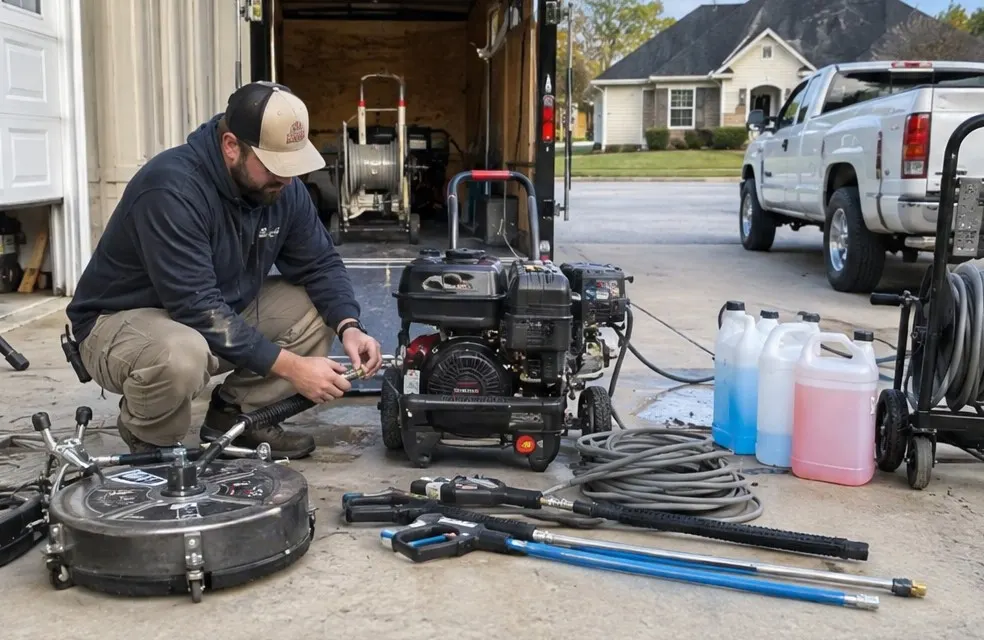
A starter kit has six parts. Machines are rated in PSI (pressure) and GPM (gallons per minute, the flow of water). Read both on the maker's spec sheet, and check that your surface cleaner is rated for your machine's pressure. We tried to read machine and surface cleaner prices from maker and store pages on 15 November 2026 and could not load them, so this guide does not quote any. The amounts in the table are round example numbers to show the sum. They are not market prices. Replace each one with two or three real quotes, new and used.
| Item | Example amount (round, not a price) | What to check | Where to get your number |
|---|---|---|---|
| Gas pressure washer, 4 GPM class | $2,000 | PSI and GPM on the spec sheet, pump type, warranty | Equipment dealers, used listings |
| 20 inch surface cleaner | $500 | Rated for your machine's PSI | Dealer or the machine maker |
| Hose, reel, gun, wands, nozzles | $400 | Hose length and pressure rating | Dealer |
| Soft wash rig for houses | $800 | Pump flow, tank size, hose | Dealer |
| Chemicals to start | $200 | Safety data sheet for each one | Janitorial or pool supplier |
| Safety gear | $150 | Eye protection, gloves, boots, hearing protection | Hardware store |
| Drain covers, berm, wet vacuum | $400 | Your city's wash water rule | Dealer, hardware store |
| Total | $4,450 |
Add the example amounts: $2,000 plus $500 plus $400 plus $800 plus $200 plus $150 plus $400 is $4,450. The truck, trailer, water tank and insurance come on top.
Chemical safety is not optional
Bleach based mixes are common in soft washing. The CDC says that you should never mix bleach with ammonia or any other cleanser. Read the safety data sheet for every product you buy, keep products in their own labelled containers and never mix two in one tank unless the maker says it is safe.
7. How many jobs do you need? A worked example
The SBA gives the formula for the break-even point: fixed costs divided by price minus variable costs. Here it is with round example numbers. These numbers show the sum. Replace every one with your own.
Fixed costs each month:
- Truck and trailer payment, plus truck insurance: $600
- Liability insurance: $130
- Equipment repairs set-aside: $200
- Phone and software: $120
- Marketing: $150
- Total: $1,200
Per job: a 1,000 square foot driveway at $150. A solo owner takes about 2 hours including setup and pack-up (an assumption: time your own). Fuel, chemicals and water cost about $8 an hour, so $16. Each job leaves $134.
Break-even: $1,200 divided by $134 is 8.96, so 9 jobs a month cover your fixed costs. You earn nothing yet.
Paying yourself $3,000 a month before tax: ($1,200 plus $3,000) divided by $134 is 31.3, so 32 jobs a month.
Is the time there? 32 jobs at 2 hours is 64 hours on site. That fits in a month. The limit for a one-person business is customers, not hours.
How fast does the kit pay back? $4,450 divided by $134 is 33.2, so about 34 jobs. At 32 jobs a month, that is a little over a month of work.
The example job reappears in our other guides. The guide on how much to charge for pressure washing shows where the $150 comes from.
8. Plan for tax and for your first helper
You work for yourself, so no employer takes tax out. The IRS says that the self-employment tax rate is 15.3%, on top of income tax. It also says that sole proprietors generally have to make estimated tax payments if they expect to owe tax of $1,000 or more when their return is filed. Move a share of every payment into a separate savings account, and ask an accountant what share is right for you.
Keep a mileage log from day one. The IRS lists a standard business rate of 76 cents a mile for July 1 to December 31, 2026. Ask your accountant whether that method or actual costs fits your truck better.
A helper costs more than the hourly rate. The IRS lists the employer share of payroll tax at 6.2% for Social Security and 1.45% for Medicare, which is 7.65%. At an example wage of $18 an hour, that adds $1.38, so the helper costs $19.38 an hour before workers' compensation. Pick your own wage from what local job ads pay.
Do not call a helper a contractor only to skip payroll tax. The IRS says that facts that provide evidence of the degree of control and independence fall into three categories: behavioral, financial and type of relationship. If you set the hours, the method and the equipment, that points toward an employee. Ask an accountant.
9. Your first 30 days
- Week 1: Get your EIN. Call your city about licenses and wash water. Request three insurance quotes.
- Week 2: Pick your structure and open the bank account. Price your equipment and buy it.
- Week 3: Time yourself on three driveways of different sizes. Use the method in how much to charge for pressure washing.
- Week 4: Wash a friend's driveway and photograph it before and after. Complete your Google Business Profile. Put your prices on a simple page. Our guide on how to get pressure washing customers has the full list.
Measuring each driveway by driving there is slow. The pressure washing cost calculator takes the square footage from the satellite map, and how to measure a driveway and a house from the satellite map shows the steps.
Where WashPilot fits
WashPilot is built for owners with one or two trucks. It gives you a website on your own .com, a satellite estimate calculator and an AI receptionist that answers calls while the machine is running. You can see your site free before you pay. It does not replace insurance, licenses or an accountant, and it does not do payroll. The software guide compares it with other tools.
Frequently asked questions
How much does it cost to start a pressure washing business?
It depends on your truck, machine and state. The start-up worksheet in this guide uses round example amounts to show the sum; replace them with two or three real quotes for each item, new and used, and add insurance and registration.
Do I need a license to start a pressure washing business?
Usually a state business registration and a local business license or tax receipt. Some states treat exterior cleaning as contracting and some do not, and cities have wash water rules, so ask your city, your state revenue department and your state contractor board.
Is pressure washing the same as power washing?
Customers use both terms for the same job, so use both on your website. If a customer asks which you use, tell them what your machine does: cold or hot water, and the pressure and flow in PSI and GPM.