Pricing
How to Measure a Driveway, Roof or House From the Satellite Map
Quote pressure washing jobs without driving out: how to measure driveways, house walls and roofs on a satellite map, the roof slope arithmetic, a test of your own accuracy and how to quote a range.
 WashPilot6 min read
In this article
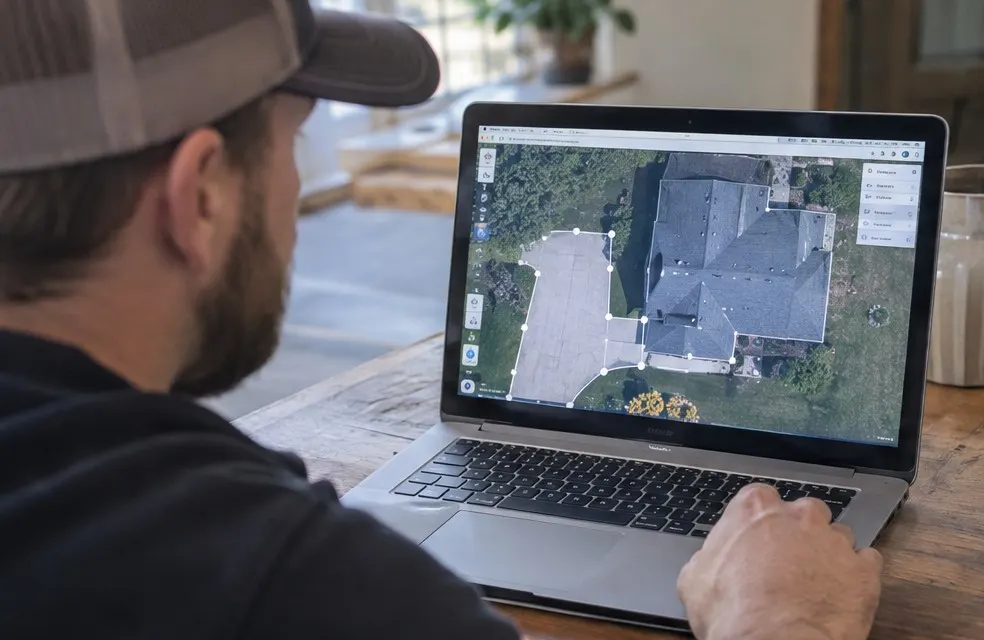
To measure a driveway, roof or house from a satellite map, search the address in the satellite view, zoom in until the edges are sharp, click around the edge of the surface and close the shape. The map gives you the area. How close it is to the real area is something you measure yourself: take a tape to five finished jobs, compare, and use your own error to decide how wide a price range to quote. This guide shows the steps for each surface, the arithmetic for roofs and walls, and a worked example of quoting a range.
Google says that measurements may not be 100% accurate, so this guide does not claim a percentage. All dollar figures are round example numbers, the same ones as in how much to charge for pressure washing: $100 an hour for a two person crew, 30 minutes of setup and 1,000 square feet washed an hour. They are an assumption: change every one to yours. Nothing here is legal or tax advice.
What are the basic steps?
Google describes the tool for Google Earth. On a computer, it says to click Measure, click the map to set points and, to measure an area, connect to your first point to close the shape and you will find the area. The same page says that measurements don't account for changes in elevation and that for the best results you should measure from a top-down view. So:
- Type the address and open the satellite view
- Zoom in until the edges of the surface are sharp
- Click around the edge, one corner at a time
- Close the shape and read the square feet
- Measure separate surfaces as separate shapes, so you can price them differently
How do you measure a driveway and flat work?
Start at the street edge and trace up to the garage door. Then add separate shapes for the front walk, the public sidewalk if the customer wants it, side paths and any parking pad. Measuring them separately lets you show the price with and without each one.
Check the number against common sense. If you get 1,400 square feet for a two car driveway, you probably traced part of the lawn. Watch for three things on the image: tree cover that hides the edge (follow the visible edges and connect them in a straight line), carports and covered entries, and parked cars at the edge.
How do you measure a pool deck, a patio or a fence?
For a deck, trace the outer edge and then trace the pool as a second shape, and subtract it. Where a screen enclosure covers the deck, the screen shows as a haze over the surface, so check the edges against street view or a photo from the customer.
A fence is priced by length, not area. Google Maps has a distance tool: you can measure the distance between 2 or more points on the map. Right click the start point, choose Measure distance and click along the fence line. Ask whether the customer wants one side or both. The neighbor's side doubles the work and needs the neighbor's permission.
How do you measure a roof?
Trace the roof outline, including the overhangs. That gives you the footprint, which is the area seen from above. A sloped roof has more surface than its footprint, and the extra comes from geometry, not from a table you have to trust. The slope factor is the square root of 1 plus the square of the pitch, where the pitch is the rise per foot of run (6 in 12 is 0.5):
| Pitch (rise in 12) | Arithmetic | Factor |
|---|---|---|
| 4 in 12 | square root of (1 + 0.333 x 0.333) | 1.054 |
| 6 in 12 | square root of (1 + 0.5 x 0.5) | 1.118 |
| 8 in 12 | square root of (1 + 0.667 x 0.667) | 1.202 |
| 12 in 12 | square root of (1 + 1 x 1) | 1.414 |
Example: a roof footprint of 2,400 square feet at 6 in 12 is 2,400 times 1.118, or 2,683 square feet of roof. Find the pitch from the customer, from a photo you ask for or from the roofing records. Do not climb a roof to find it. NIOSH says that falls in the workplace frequently involve unprotected edges and unsafely positioned ladders, and this guide does not teach roof work. Read NIOSH's page before you quote any roof.
How do you measure a house?
Pricing by living area is the simplest. On a one story home, the footprint from the roof outline is close to the living area. On a two story home, double it. Confirm with the customer or the county property record.
If you price by wall area instead, measure the perimeter and multiply by the wall height. Example: a 50 by 40 foot house has a perimeter of 180 feet. At an assumed 10 feet of wall height per story, that is 1,800 square feet before you subtract windows and doors. Measure one wall on a photo or on site to replace the 10 feet.
How accurate is your measuring? Test it.
We could not find a published accuracy for measuring a driveway on a satellite map, and it depends on the tree cover, the image and you. So measure it. Take five jobs you have already washed, measure each with a tape, and compare:
| Job | Tape | Map | Error: (map minus tape) divided by tape |
|---|---|---|---|
| A | 640 sq ft | 610 sq ft | minus 4.7% |
| B | 1,180 sq ft | 1,260 sq ft | plus 6.8% |
| C | 420 sq ft | 405 sq ft | minus 3.6% |
These three rows are made-up example numbers to show the sum, not our measurements. Their errors, ignoring the sign, average 5.0 percent. Your own five jobs give you your own number, and it will be different for open lots and for lots under trees.
How do you quote a range from a measurement?
Use your own error to bracket the price. Example: the map says 1,200 square feet and your test says plus or minus 10 percent (an assumption, replace it).
- Low: 1,080 square feet. 0.5 hours of setup plus 1.08 hours is 1.58 hours, so $158
- High: 1,320 square feet. 0.5 hours plus 1.32 hours is 1.82 hours, so $182
Quote "$160 to $180, confirmed when we measure on site" and walk the surface when you arrive. If the real area is outside your range, tell the customer before you start, not after.
What can make the image wrong?
Satellite photos have a date. Google says that an imagery date or range of dates may not be available in all locations or at all zoom levels. A new paver extension, a pool or a second driveway may not show. Check street view, and ask the customer: "Has anything changed out front in the last couple of years?"
What does measuring from the map save?
Driving out to measure costs time and fuel. Assume 45 minutes at the example owner cost of $60.50 an hour: $45.38 before fuel, on each quote, and some of those quotes never book. Count your own drive-outs for a month and multiply. A quote from the map takes the minutes it takes to trace a shape, and you confirm on site on the day of the job.
Can the customer measure it for you?
With the estimate calculator on your site, the homeowner types the address, outlines the driveway, roof, house or deck on the satellite map and sees your price range for those square feet. You receive the address, the measured square feet and the extras, and you confirm on arrival. You can try the idea on the free pressure washing cost calculator. The measurement is the customer's outline, so the same accuracy test applies: compare a few of them with your tape.
Once you have the square feet, the price comes from your rates. See how much to charge for pressure washing and driveway pressure washing cost.
Frequently asked questions
How accurate is measuring a driveway on a satellite map?
Google says its measurements may not be 100% accurate. We could not find a published accuracy for driveways, so measure five finished jobs with a tape, compare, and use your own error to set the width of the price range you quote.
How do I measure a roof from a satellite map?
Trace the outline with the overhangs, then multiply by the slope factor, which is the square root of 1 plus the square of the pitch. A 6 in 12 roof is 1.118, so a 2,400 square foot footprint is about 2,683 square feet of roof. Get the pitch from the customer or a photo, and do not climb a roof to find it.